
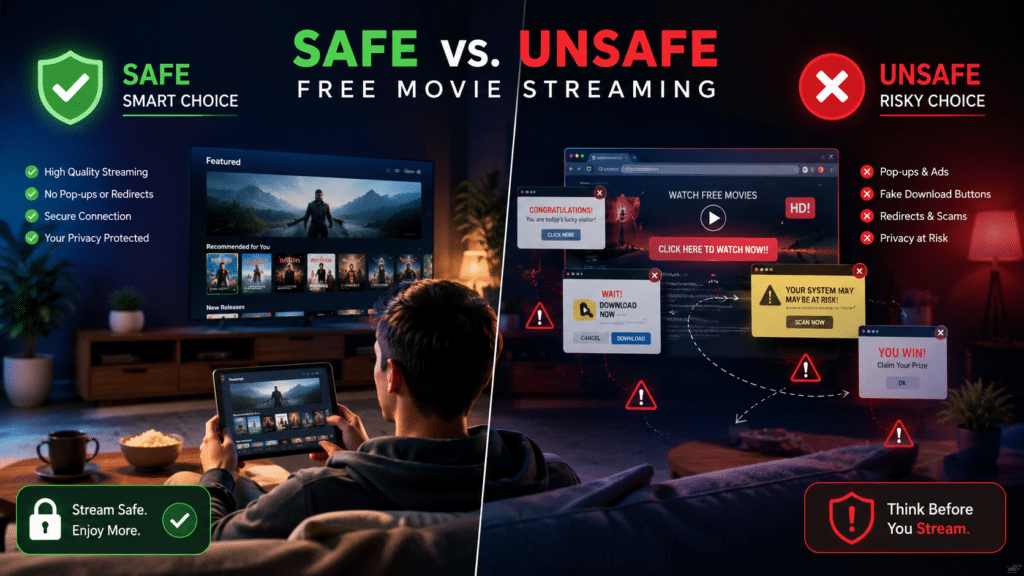
Is Watching Free Movies Online Safe? A Practical Guide to Streaming Without Risk
On a Friday night, you’re at your computer and want to stream something. You already know about the sketchy sites. You already know how scary bugs can be. But you also know that real free video sites do work. You want the real answer before you sign up for a service you might not use. Is it safe to watch free movies online? Yes, if you know where to look.
That’s what this book is all about. Do not be afraid. Not ideas of conspiracies. Just the truth.
There are two main types of writing on this subject. Either VPN companies are trying to scare you into buying their service, or they’re just general safety alerts that don’t help. This one is different. You will learn the real difference between sites that are safe and sites that let you steal things. You’ll know the difference between the real risks and the nonsense that people spread.
You’ll also learn real ways to stay safe without having to buy anything.
Is Watching Free Movies Online Safe? The Honest Answer
Let’s start with the thing everyone wants to know straight up. Can you watch free movies online safely?
Yes, but there is a very important catch. Free platforms that are legal and have proper licensing deals are safe. Piracy sites, on the other hand, are not safe. This difference is important because many stories mix them up. They mix up legal and illegal services and then try to sell you a solution, which is usually a VPN, as if that solves both issues.
That’s not how it works.
There isn’t much risk when you use a real free streaming service like Tubi or Pluto TV. Studios have made deals with these sites to use their content. They watch out for their ads. They have rules about protection and a system for keeping things safe. It’s not safer to use them on your computer than to watch YouTube.
You put yourself in real danger when you use a site for theft. Spreading malware, phishing scams, and collecting data. There are real risks because pirate sites are on the edge of the law and don’t put money into protecting their users.
Knowing this difference is the first step to safely streaming.
The Difference Between Legitimate Platforms and Piracy Sites
Here’s where most guides get it wrong. They treat all free streaming as inherently risky. That’s false. The risk level depends entirely on whether the site has proper licensing.
How Legitimate Platforms Actually Work
A legitimate streaming platform operates on what’s called an AVOD model. Advertising-supported video on demand. Studios and distributors grant the platform the right to stream specific content. Money changes hands. Licensing agreements get signed. Everything is above board. When you use these platforms, you’re not breaking laws, and you’re not putting yourself in danger.
Think of it like the difference between watching a movie on your cable TV box versus downloading it from a random torrent site. One is legal and safe. The other is neither.
How Piracy Sites Operate
Piracy sites work differently. They don’t have licensing agreements. They host copyrighted content without permission. Some use torrents. Others stream directly. All of them operate knowing they’re breaking copyright law. They make money from ads, but they don’t police those ads carefully. Why would they? They’re already breaking the law.
The Key Questions to Ask
How do you tell the difference? Start by asking yourself: Does this company have a clear, transparent business model? Legitimate platforms explain how they work. They talk about their licensing deals. They have clear privacy policies. Piracy sites are murky. They make vague promises about “free content” without explaining how they’re funding operations. No legitimate company making millions from ads avoids transparency.
Red Flags in the Details
Look at the domain name. Does it match the company name, or does it look like random letters? Does the site have professional branding or does it look like it was built in 2005? Does it require you to create an account with full personal information before you can watch anything? These are yellow flags.
Check for an “About Us” page that actually says something substantive. Legitimate companies explain their history and mission. Fly-by-night piracy operations rarely bother.
The Ultimate Test
Most importantly, if it sounds too good to be true, it is. If a site promises unlimited movies with no ads and no account required, that’s not sustainable unless it’s doing something illegal.
The Real Safety Risks of Free Streaming (Separated From Hype)
Every article about free streaming safety mentions five things: malware, phishing scams, data privacy, legal risk, and pop-up ads. What they don’t do is explain which ones are actually realistic threats.
Let’s be specific.
Malware: Real on Piracy Sites, Minimal on Legitimate Ones
Malware risk on legitimate platforms is low. Tubi, Pluto TV, YouTube, and Plex all have teams that review advertisements before they go live. That’s not perfect, but it means the risk of accidentally clicking a malicious ad and getting infected is minimal. On piracy sites, malware risk is high. These sites either don’t review ads at all or actively distribute malware as part of their revenue model.
Phishing Scams: Avoid Clicking Random Links
Phishing scams exist everywhere online. Someone sends you an email pretending to be from your streaming platform, asking you to verify your password. If you use legitimate platforms that don’t store your credit card information (many free ones don’t), the damage potential is limited. Your concern is mainly your email security, not the platform itself.
Data Privacy: Know What You’re Trading
Data privacy is worth discussing. Legitimate platforms collect data about what you watch. That’s how they improve their algorithms and sell advertising. It’s annoying but legal. They sell aggregated, anonymised data about viewing habits. They don’t sell your name and address to the highest bidder. Piracy sites collect data too, and without any of the legal safeguards.
Legal Risk: Using Licensed Content Is Not Illegal
Legal risk from watching free movies on legitimate platforms is basically zero. You’re using a service that the copyright holders licensed. You’re not breaking any laws. The argument that copyright holders could sue you individually for watching licensed content makes no sense legally. They signed the licensing deal. They accepted the terms. On piracy sites, legal risk is real. Copyright holders have sued individual users. It’s rare, but it happens.
Pop-Up Ads: They’re Annoying But Harmless If You Ignore Them
Pop-up ads are annoying. Some sites have more aggressive pop-ups than others. Pop-ups themselves don’t infect your device. Clicking on the malicious ads inside them does. Don’t click them and you’re fine.
ISP Tracking: Privacy Concern, Not a Safety Issue
The one area where both legitimate and piracy sites are comparable is ISP tracking. Your internet service provider can see what sites you’re visiting. If you’re on a piracy site, they know it. If you’re on a legitimate free platform, they can see that too. This is where people talk about needing a VPN. Here’s the honest part: if you’re in the US, UK, Canada, or Australia and using legitimate platforms, your ISP isn’t going to care. They’re not monitoring your streaming activity to the level people imagine. And if you’re concerned about general privacy, that’s a separate issue from streaming safety.
How Piracy Sites Actually Harm Your Device
Most guides warn you about “malware” without explaining how it actually gets onto your device. That’s deliberately vague, and it feeds fear. Let me be specific.
Malicious Advertisements and Adware
Piracy sites make money by showing you advertisements. Lots of them. Because they’re not screening ads carefully, sometimes those ads contain malicious code. You click on an ad thinking it’s a skip button or a play button, and instead, you install adware. Adware slows your device down and hijacks your browser to show you ads constantly.
Ransomware Through Fake Downloads
Some piracy sites go further. They bundle software downloads with malware. You download what you think is a movie player, and instead, you get ransomware. Ransomware locks your files and demands payment to unlock them. It’s rare for casual users, but it happens.
Data Harvesting for Identity Theft
Data harvesting is another tactic. Some piracy sites collect information from your device to sell to advertisers or to use in identity theft schemes. They’re looking for saved passwords, financial information, anything with value.
DDoS Attacks Using Your Device
The most sophisticated piracy operations actually use their user base to launch DDoS attacks. If you’re on their site, your device could be used to attack other sites without your knowledge. You’re not liable, but your internet connection is involved.
Browser Hijacking and Redirect Schemes
Browser hijacking is common. You visit a piracy site, and the next time you open your browser, your home page has changed. Your search engine has changed. Ads follow you everywhere. It’s not dangerous in the traditional sense, but it’s invasive and annoying.
Why Piracy Sites Don’t Care About User Safety
These things happen on piracy sites because they don’t care about user safety. Their entire business model is already illegal. They’ve made the calculation that breaking copyright law is profitable. Adding malware distribution to the mix just increases profits.
Is Watching Free Movies Online Safe on These Platforms? 8 You Can Trust
So what platforms actually qualify as safe? Here are eight that have proper licensing, security practices, and professional infrastructure.
Tubi is owned by Fox Corporation. It has 40,000 titles and grows daily. They’re licensed by studios to distribute content. They police their advertisements. You don’t need an account to start watching, though creating one improves recommendations. Is watching free movies online safe on Tubi? Yes. They have security protocols, transparent business practices, and proper licensing.
Pluto TV operates on a similar model to cable. 250 live channels plus on-demand content. Owned by a major media company with infrastructure and security practices. Safe platform.
YouTube doesn’t need an introduction. Official movie channels stream full-length films legally. Search for “full movie free with ads”, and you’ll find thousands. YouTube’s security is as strong as it gets.
Plex is more than just a streaming service. It integrates with your personal media library. The free movies section is clean and well-organised. Professional operation with security measures in place.
Kanopy requires a library card, but is completely free otherwise. It focuses on independent and international cinema. Public libraries negotiate these partnerships, so the vetting is rigorous. If it’s available at your library, it’s safe.
Crackle is owned by Sony. It offers older titles and occasionally original content. Professional security and licensing. Safe platform.
The Roku Channel isn’t just for Roku devices. It works on smart TVs, phones, browsers, and multiple streaming devices. Owned by a major technology company. Professional security and advertising standards.
Freevee is Amazon’s free tier. Newer content than some competitors, still with proper licensing and security infrastructure. Safe platform.
All of these platforms have one thing in common. They’re backed by major companies or major funding. They have clear business models. They have privacy policies and terms of service. They’re not hidden in legal grey zones. That’s what makes them safe.
How to Actually Protect Yourself When Streaming
If you’re using any of the eight platforms above, you don’t need special tools. You don’t need a VPN. You don’t need expensive antivirus software. You need basic common sense.
Rule #1: Don’t Click on Random Pop-Ups
First, don’t click on random pop-ups. If you see an ad that looks suspicious, close it. Don’t click the X button if that button is part of the ad. Close the entire tab and go back. This simple rule prevents 90% of malware infections.
Rule #2: Use an Ad Blocker When Needed
Second, use an ad blocker if ads bother you. On legitimate platforms, ad blockers won’t break the service and they’ll improve your experience. On piracy sites, ad blockers might prevent you from accessing anything, which is probably the universe telling you to leave anyway.
Rule #3: Keep Your Device Updated
Third, keep your device updated. Updates include security patches. They matter. Not just for streaming but for everything.
Rule #4: Use Strong, Unique Passwords
Fourth, use a strong password if the platform requires login. Don’t reuse passwords across sites. Use a password manager if remembering them is a problem.
Rule #5: Trust Your Gut
Fifth, think before you trust. If a site seems off, it probably is. Your gut feeling about legitimacy is usually accurate.
That’s honestly it. You don’t need to buy anything. You don’t need complicated security solutions. You need awareness and restraint.
The VPN Question: When You Actually Need It
Now, about VPNs. When you hear that a VPN is essential for watching free movies online safely, that’s usually a company trying to sell you a VPN. In reality, a VPN is useful if you’re in a country where certain platforms are geoblocked. It’s not useful for general security on legitimate platforms because those platforms don’t have security vulnerabilities that a VPN would fix. A VPN encrypts your traffic, which prevents your ISP from seeing what sites you visit. That’s useful if you care about ISP-level privacy. It’s not specifically necessary for stream safety.
The one exception is if you’re using a piracy site. A VPN prevents your ISP from seeing that you’re visiting illegal sites. But the answer to that problem isn’t “use a VPN on piracy sites.” The answer is “don’t use piracy sites.”
Red Flags That Scream “This Site Is Unsafe”
You want to know how to spot a piracy site before you accidentally use one? Look for these signs.
Red Flag #1: No Clear Company Information
No clear company information. If you can’t find an About Us page with real details about the company, that’s a warning.
Red Flag #2: Excessive Pop-Ups
Excessive pop-ups. Especially pop-ups that appear before you even try to play anything. Legitimate platforms don’t bombard you with ads immediately.
Red Flag #3: Requests for Excessive Personal Data
Requests for personal information up front. Want to watch one movie? Create an account with your full name, email, phone, and birthday. That’s a data harvesting operation.
Red Flag #4: Missing Legal Documents
No terms of service or privacy policy. Legitimate companies have legal documents. Piracy sites skip this because they’re not operating legally anyway.
Red Flag #5: Suspicious Domain Names
Domains that look generated randomly. Real companies have real domain names. Piracy operations often use variations of popular names to trick people. Look at the full URL, not just the part people type.
Red Flag #6: Required Downloads to Watch
Downloads required to watch. Legitimate platforms stream in browsers. Anything that requires you to download an app or software from their site is suspect.
Red Flag #7: Unprofessional Design
Inconsistent design. Real companies invest in user interface. Piracy sites often look like they were built in 2003 and never updated.
Red Flag #8: Impossible Quality Promises
Streaming quality that seems impossible. Promising 4K movies immediately when even paid Netflix takes time to buffer. Probably not real.
Red Flag #9: No Ads Anywhere
No ads at all. Free services have to make money somehow. If there are genuinely no ads anywhere, the business model is likely illegal.
Red Flag #10: Hidden Subscription Attempts
Pressure to subscribe or buy anything. Legitimate free platforms let you watch for free. They don’t trick you into paid tiers hidden in the interface.
These signs don’t guarantee a site is illegal, but together they form a pattern that indicates danger.
Your ISP, Your Privacy, and Streaming
What Your ISP Actually Sees
One thing worth addressing specifically: your internet service provider sees what sites you visit. This is true whether you’re on legitimate or piracy sites. Your ISP knows you visited Tubi. They know your neighbours visited Pluto TV. This is just how the internet works.
Should You Actually Care?
Should you care? That depends on your comfort level with privacy. Some people don’t like the idea of their ISP building a profile of their viewing habits. That’s a valid concern unrelated to safety.
How a VPN Helps (And Doesn’t)
If you care about ISP-level privacy, a VPN is actually useful. It hides your browsing from your ISP. Your ISP sees you’re using a VPN. They don’t see which sites you’re visiting through it.
But again, this is a privacy issue, not a safety issue. You’re no less safe if your ISP knows you watched Tubi. You’re just less anonymous.
The VPN Marketing Trap
The difference matters because VPN companies often blur the lines. They’ll imply that using their VPN makes you safer. In reality, it makes you more private. On legitimate platforms, you don’t need privacy from your ISP. On piracy sites, a VPN doesn’t make them safe. It just makes them more anonymous.
The Real Scenario: Sarah’s Movie Night
To make this concrete, let me walk through what a safe, free movie night actually looks like.
What Safe Streaming Actually Looks Like
Sarah wants to watch a movie. She opens her browser and goes to Tubi. She searches for a horror film. She finds something that looks interesting and clicks play. An ad plays. She waits 30 seconds. The movie starts. She watches for 90 minutes with occasional ad breaks. The movie ends. She closes the browser.
Did she need a VPN? No. Is her device compromised? No. Did she break any laws? No. Is her privacy violated in any meaningful way? She might not love that Tubi knows she watches horror movies, but that’s just how free services work.
What Unsafe Streaming Looks Like
Now, contrast with someone using a piracy site. They search Google for “watch movies free no ads.” They find a site that promises exactly that. They click. The browser redirects three times before they get to the movie. There are pop-ups everywhere. They click what they think is the play button, but it’s actually an ad that tries to redirect them to a casino. Their antivirus blocks something malicious. They finally get the movie playing, but they’re nervous the whole time. And now their browser’s home page is different, and ads follow them around for weeks.
The difference is obvious in practice, even if it’s not obvious in theory.
Is Watching Free Movies Online Safe? Final Thoughts
The answer to whether watching free movies online is safe is yes. Completely yes. On legitimate platforms, it’s as safe as anything else you do online.
The qualifier is important, though. That safety only exists if you’re using licensed platforms. Piracy sites are genuinely risky, and you should avoid them.
You don’t need expensive security tools to stream safely. You don’t need a VPN. You don’t need anything beyond basic caution and common sense.
Start with one of the eight platforms mentioned. Spend 20 minutes exploring. See what’s available. You’ll find something worth watching, and you’ll do it safely without spending money or compromising your device.
The false choice that gets presented is to pay for a subscription or risk losing your device. That’s not reality. The real choice is to pay for a subscription or use one of the many safe, free, legal platforms available right now.
Pick the second one. Your wallet and your peace of mind will thank you.
Is it actually safe to watch free movies online?
Yes. Legitimate platforms are safe. Piracy sites are not. The difference is licensing and company legitimacy.
Can I get sued for watching free movies?
Not if you’re using legitimate platforms. They handle the legal agreements with studios. You’re not liable. On piracy sites, technically, copyright holders could pursue it, but they usually don’t bother with individual users.
Do I need a VPN to watch free movies safely?
No. Legitimate platforms are safe without a VPN. VPN helps with geoblocking and ISP-level privacy. It doesn’t add safety on legitimate platforms.
What about the malware warnings I keep seeing?
Some are real, some are from VPN companies trying to scare you. Malware risk on legitimate platforms is minimal. On piracy sites, it’s real.
Can my ISP see what I’m watching?
Yes, your ISP can see what sites you visit. They can see you visited Tubi. They don’t know which specific movie you watched. If privacy concerns you, use a VPN. If you’re just worried about safety, a VPN isn’t necessary.