
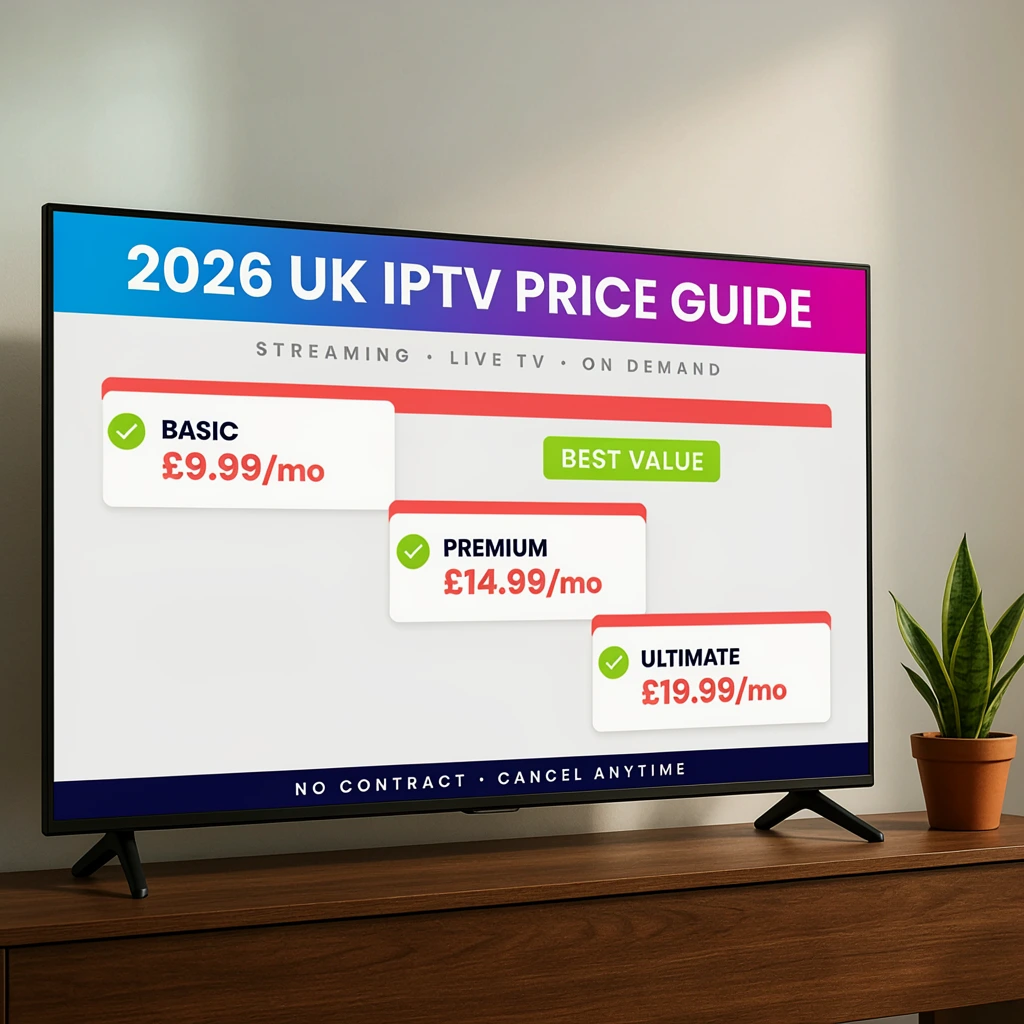
How Much Do IPTV Services Cost in the UK?
Key Takeaways
- Traditional pay TV in the UK now regularly costs £60 to £90 a month once sport and film add-ons are included, before broadband is even factored in.
- A UK TV licence costs £180 a year (£15 a month) from April 2026, and you need one for any live TV viewing or BBC iPlayer use, regardless of which service you watch it through.
- IPTV subscription pricing across the UK market varies enormously, from single figures a month to £15 or more, and price alone tells you very little about reliability.
- NOW TV memberships (Sky’s contract-free option) start from around £7.99 to £9.99 a month per pass, with Sports currently at £34.99 a month standalone.
- The cheapest legal route for many households is a mix of free-to-air (BBC iPlayer, ITVX, Channel 4, My5) plus one or two paid subscriptions, rather than one all-in-one bundle.
- Annual or longer-term IPTV plans tend to work out cheaper per month than rolling monthly ones, mirroring the same pattern you see with Sky and NOW.
- Price should never be the only factor. Stream stability, device support, and what happens if the service disappears matter just as much as the monthly figure.
Ask ten people how much IPTV costs in the UK and you’ll get ten different answers. Some will quote you a fiver a month. Others will tell you it’s closer to fifteen quid. Neither is wrong, exactly. IPTV pricing across the UK spans a genuinely wide range, and where a given service sits on that range usually tells you something about what you’re actually getting.
This guide breaks the numbers down properly. We’ll look at what traditional pay TV costs in 2026, what the TV licence adds on top, where IPTV pricing typically sits, and the questions worth asking before you hand over your card details to anyone.
What Does “IPTV” Actually Mean?
IPTV, or Internet Protocol Television, is simply TV delivered over your broadband connection instead of through a satellite dish or a cable box. If you’ve ever watched Sky Go, used BBC iPlayer, or streamed a match through an app on your Fire Stick, you’ve used IPTV technology. It isn’t one single thing you buy. It’s a delivery method, and different providers build very different services on top of it.
That distinction matters for pricing. A companion IPTV access layer that streams channels and content to your existing devices costs a fraction of what it costs a broadcaster to license content, run a satellite network, and staff a call centre. That’s the structural reason IPTV pricing sits well below Sky or Virgin Media, not a trick or a loophole.
How Much Do IPTV Services Cost in the UK in 2026?
Before comparing anything, it helps to know what the baseline actually is. Here’s where the big three sit this year.
Sky TV Pricing 2026
Sky’s cheapest route in is Sky Stream with the Essential TV package, which starts from around £15 a month on a rolling 31-day term. Step up to the full Sky Entertainment package, and pricing starts around £17 a month, with Sky Sports added on top pushing the total to roughly £30 a month and Sky Cinema adding a further £11. Once you stack sports and film together, a lot of households land somewhere between £45 and £75 a month for the TV package alone, before broadband.
Sky isn’t shy about raising prices either. Sky Cinema rose by around £1 a month when taken with a TV product from April 2026, and triple-play bundles combining broadband, TV and phone rose by roughly £3 a month, with existing customers seeing similar increases land through their billing over the same period. Existing Sky TV subscribers saw their direct debits rise by between £1 and £3 a month from April 2026, worth up to £36 a year for the same package they already had.
Virgin Media TV Pricing 2026
Virgin doesn’t sell TV on its own. Every TV package rides on top of a broadband contract. The entry-level Maxit TV package runs around £25 a month with 110-plus channels, rising to roughly £35 for Bigger TV with 190-plus channels, £45 for Bigger TV plus Movies, and £50 for Bigger TV plus Sports. Those figures are for the TV element only, so broadband gets added separately, and Virgin’s headline offers typically come with an 18-month minimum term attached.
NOW TV Pricing 2026
NOW is Sky’s no-contract streaming option and the closest thing traditional broadcasting has to an IPTV-style model. Standard pricing runs at £7.99 a month for Entertainment, £9.99 for Entertainment with HBO Max, £9.99 for Cinema, and £34.99 for Sports. A Sports Day pass is available at £14.99 for 24 hours if you only need one match. Six-month saver deals bring the monthly figure down further, and signing up for a six-month plan typically saves around 30% compared to the flexible monthly one.
The TV Licence Fee
This one catches people out constantly, and it’s worth being blunt about it: it applies no matter which box or app you’re watching through. The TV licence fee changed on 1 April 2026, with a colour licence now costing £180 a year and a black and white licence £60.50. That works out to roughly £14.54 to £15 a month depending on how you spread the payments.
You need a licence if you watch or record anything live, on any channel, through any provider, or if you use BBC iPlayer at all, live or on demand. You do not need one for on-demand-only services like Netflix, Disney+, Prime Video or Apple TV+, or for other on-demand apps that aren’t iPlayer. It’s worth checking honestly whether you actually need one before assuming it’s a fixed cost, because for some households it genuinely isn’t.
How Much Do IPTV Subscriptions Typically Cost?
This is the question most people are actually here for, and it’s the hardest one to answer with a single number because the market is wide and inconsistent. Reported pricing across UK-facing IPTV services in 2026 clusters into a few rough bands, but treat any specific figure as a snapshot rather than gospel. Prices move constantly, and headline rates from review sites don’t always match what you’ll be charged at checkout.
At the very low end, sub-£4-a-month pricing tends to correlate with thin channel lists, overloaded shared servers, and streams that hold up fine at 3pm on a Tuesday and fall over the second a big match kicks off. At the upper end, well into double figures a month, you’re usually paying for more simultaneous connections, dedicated infrastructure, and a company that’s been trading long enough to have a support team worth contacting.
What Affects IPTV Pricing?
A handful of factors explain most of the spread you’ll see:
- Contract length. Monthly rolling plans cost more per month than six-month or annual commitments, the same pattern Sky and NOW follow.
- Simultaneous connections. A plan supporting one stream is a different product from one supporting four devices running at once, even at the same headline price.
- Server infrastructure and location. Providers routing traffic through proper UK-facing infrastructure tend to sit in the middle of the price range rather than the bottom, because that capacity costs money to run.
- Currency quoting. Some providers list prices in US dollars and convert at checkout, which can add a meaningful markup versus a price already quoted in pounds.
- What’s actually included? Catch-up windows, EPG quality, and on-demand libraries vary a lot between services charging similar headline prices.
Red Flags: Prices That Are Too Good to Be True
A few patterns are worth treating with real caution rather than curiosity:
- Lifetime access for a one-off fee. Ongoing server costs don’t stop after the sale. A single flat payment covering years of hosting rarely adds up, and services built this way tend not to last.
- No trial period at all. A provider confident in its own stream stability usually lets you test it first.
- Prices well below the rest of the market with no explanation. If everyone else is charging £8 to £15 and one option is £2, ask what’s being cut to get there.
- No clear refund or cancellation terms. A reasonable money-back window is a basic sign of a business that expects to keep customers rather than churn through them.
Free-to-Air Options: What You Get Without Paying
It’s easy to forget how much is available without any subscription at all, IPTV or otherwise. BBC iPlayer, ITVX, Channel 4 and My5 give you live and catch-up access to Britain’s biggest free-to-air channels, all covered by your TV licence if you’re already paying it. Freeview and Freely deliver over a hundred channels through an aerial or broadband connection with no subscription attached beyond the licence itself.
For a lot of UK households, the honest starting point isn’t “which paid service should I get” but “what am I missing from free-to-air that I’d actually pay to fix.” Sky Sports and TNT Sports coverage of the Premier League, certain film premieres, and some US drama are the genuine gaps. Everything else is arguably already covered.
IPTV vs Traditional Pay TV: Real-World Cost Comparison
| Route | Typical monthly cost | Contract | TV licence needed? |
|---|---|---|---|
| Sky (Entertainment + Sports + Cinema) | £45–£75+ | 24 months or 31-day rolling | Yes |
| Virgin Media (Bigger TV + Sports) | £50+ (TV only, excludes broadband) | Typically 18 months | Yes |
| NOW TV (Entertainment + Sports, flexible) | £40–£45 combined | No contract | Yes |
| Free-to-air only (iPlayer, ITVX, Freeview) | £0 beyond the licence | None | Yes |
| Typical UK IPTV subscription | Varies widely by provider and term | Usually none | Yes, if you’re watching live content |
That last row deserves a caveat: figures vary hugely by provider, term length and what’s included, so treat any single number quoted for “IPTV” as a starting point for your own research rather than a fixed market rate.
One thing that doesn’t change across any of these routes: if you’re watching live television or using BBC iPlayer, the TV licence applies regardless of which app, box or provider is delivering it to your screen.
See current ZumTV plans and pricing
What to Check Before You Subscribe to Any IPTV Service
A monthly price is only half the picture. Before committing to any IPTV subscription, it’s worth working through a short list:
- Is the price quoted in pounds, with no hidden conversion? A price listed in dollars and converted at checkout can end up costing more than it looks.
- What happens during peak hours? Ask about performance during major sporting fixtures specifically, since that’s when weak infrastructure shows itself.
- How many devices can stream at once? Compare like for like. A cheaper single-connection plan isn’t necessarily better value than a pricier multi-connection one if more than one person in the household watches TV.
- What’s the cancellation and refund policy? A defined money-back window is a reasonable minimum expectation.
- How long has the provider actually been operating? Longevity is one of the few genuine signals of stability in a crowded market.
- Does support exist, and does anyone answer? A quick test message before you pay tells you a lot about what happens if something breaks later.
Where Does ZumTV Fit In?
ZumTV is a companion streaming access layer built for UK viewers who want an easy, flexible way to watch alongside the services they already use, rather than a broadcaster or rights holder in its own right. It isn’t trying to replace your TV licence obligations or your access to free-to-air channels like BBC iPlayer and ITVX, which remain worth keeping regardless of what else you subscribe to.
Where ZumTV differs from a lot of the market is the emphasis on clear pricing, UK-facing support, and being upfront about what’s included rather than burying it in small print. Full plan pricing is confirmed directly on the ZumTV site, since it’s the kind of detail worth checking fresh rather than relying on any third-party comparison, including this one.
If you’ve been paying £60, £70, £80 a month for a traditional bundle and only actually watching a fraction of what’s included, it’s worth working out what you’d keep and what you’d drop. That’s usually where the real savings sit, not in any single headline price.
Is IPTV cheaper than Sky or Virgin Media in the UK?
Generally yes, once you compare like for like. Sky and Virgin Media bundle broadcaster licensing, satellite or cable infrastructure and long contracts into their pricing, which pushes monthly costs up. IPTV services built as a streaming access layer over your existing broadband tend to carry lower running costs, and that’s usually reflected in the price. The gap narrows if you’re only comparing a basic entertainment tier against a fully loaded IPTV plan, so it’s worth comparing what’s actually included rather than headline prices alone.
Do I still need a TV licence if I use an IPTV service?
Yes, if you’re watching or recording anything live or using BBC iPlayer at all. A TV licence is required for watching, recording or downloading live television on any channel or platform, including pay TV services and streaming services, and for anything on BBC iPlayer, whether live or not. This applies regardless of the app, box or provider delivering the content to your screen.
Why do some IPTV subscriptions cost so much less than others?
Mostly infrastructure and business model. Cheaper services often run on shared, overloaded servers that struggle under peak demand, particularly during major sporting fixtures. More expensive plans typically reflect dedicated hosting, more simultaneous connections, and a business built to operate long-term rather than to maximise short-term sign-ups.
Is a lifetime IPTV subscription a good deal?
Treat lifetime offers with caution. Running a quality IPTV service involves ongoing server, licensing and support costs that don’t stop after a single upfront payment. Services offering unlimited access for a flat one-off fee often aren’t sustainable, and a meaningful share disappears within months of taking payment.
What’s the cheapest legal way to watch TV in the UK?
For most households, it’s a combination of free-to-air apps (BBC iPlayer, ITVX, Channel 4, and My5) covered by the TV licence you’re likely already paying, plus one or two targeted paid subscriptions for the specific sport, film or drama content you actually want. Stacking every available service rarely works out cheaper than being selective about what you actually watch.
How often do IPTV and pay TV prices change in the UK?
Traditional pay TV providers like Sky and Virgin Media typically raise prices annually, often each April, sometimes mid-contract. The TV licence follows the same pattern, rising each April in line with CPI inflation. IPTV pricing tends to move less predictably, since it depends on the individual provider rather than a fixed annual review, so it’s worth checking current pricing directly before subscribing rather than relying on prices quoted elsewhere.